Incident monitoring

Track incidents in your service and create reports in real time. Just set up a regular upload of large data packages to ClickHouse. To ensure maximum efficiency, we recommend that you send at least a thousand rows at a time.

Manage a fast analytical DBMS in the Delphi Cloud infrastructure.
Invest your time in your project, and we’ll take care of database maintenance: software backups, monitoring, fault tolerance, and updates.
In Delphi Managed Service for ClickHouse, you can add hosts to a cluster, upgrade their class, and enable sharding to improve your cluster performance with just a click of a button.
ClickHouse is great at handling queries to large amounts of data in real time, while column-based storage saves space due to strong data compression.
In Delphi Managed Service for ClickHouse, you can combine network drives and Object Storage. After a certain period, data stored on a network drive is automatically transferred to Object Storage.
All DBMS connections are encrypted using the TLS protocol. Data is secured in accordance with the requirements of local regulatory, and ISO industry standards.
Visualize the data structure in your ClickHouse cluster and send SQL queries to databases from the management console.


Select the necessary computing capacity and create a ready-to-use ClickHouse cluster.
Create cluster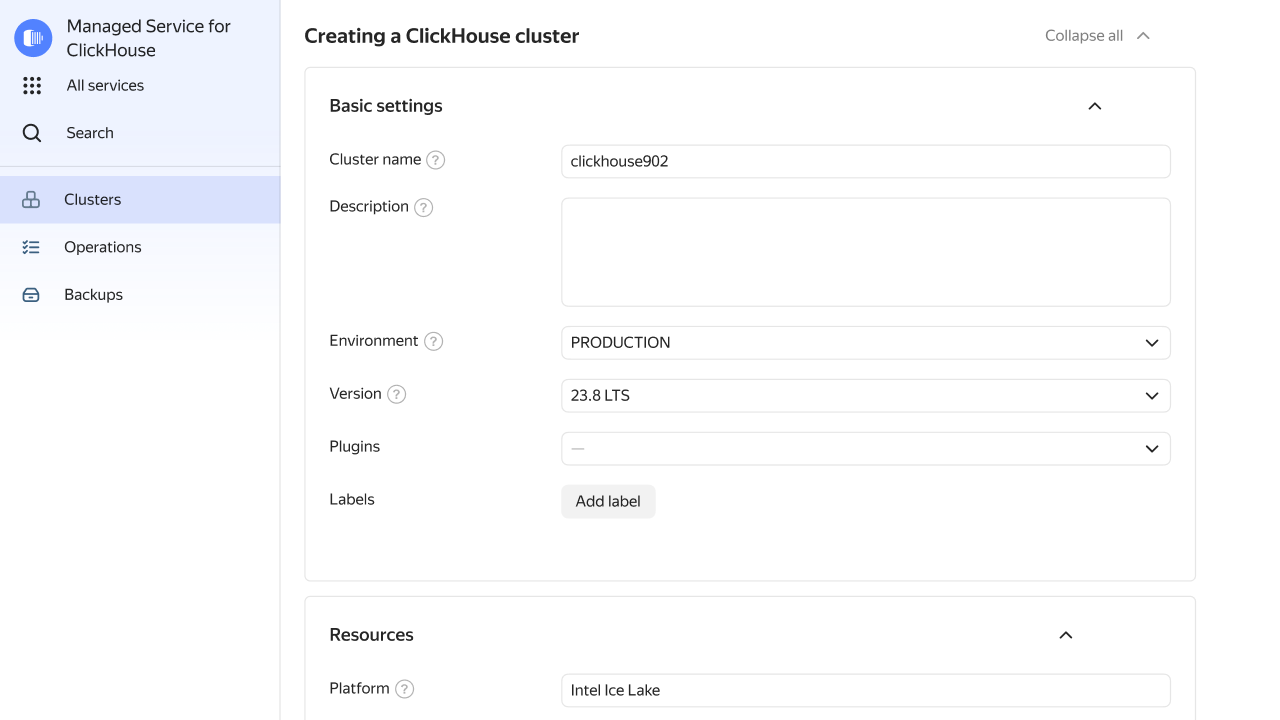
Get up to 22% in savings on managed databases in the cloud — just reserve resources for six months or a year in advance, right in the management console.

Managed Service for ClickHouse uses the latest stable version of ClickHouse. You can change the ClickHouse version that the cluster uses. You can view a list of available versions on the create and modify cluster screen in the management console.
When creating clusters, Managed Service for ClickHouse allocates resources, installs the DBMS, and creates databases. For created and running databases, it automatically creates backups and applies fixes and updates to the DBMS. The service also provides data replication between database hosts and automatically switches the load over to a backup replica in the event of a failure.
Yes. You can distribute the load across DB hosts using sharding.